Amman, September 7, 2026
The diocesan journey of the Archdiocese of Lucca, under the spiritual guidance of Archbishop Paolo Giulietti, unfolded along a fascinating path in the Hashemite Kingdom of Jordan — a cornerstone of biblical history, bearing witness to the life and legacy of influential figures of Scripture. Abraham, Job, Moses, Ruth, Elijah, John the Baptist, Jesus Christ, and Paul are among the many who walked this extraordinary land. Indeed, among the regions of the Holy Land, Jordan is the only place touched by all these towering biblical figures; its very soil breathes with the stories and revelations recorded in the Holy Bible.
The intense pilgrimage program enabled a group of 20 pilgrims to visit significant archaeological sites that testify to the history of Christianity from north to south Jordan: Tell Mar Elias, believed to be the birthplace of the prophet Elijah, located on a hill near Ajloun; Umm Qays, traditionally identified as biblical Gadara, offering a spectacular view of the Sea of Galilee; Anjara, an ancient city in the hills of Gilead east of the Jordan Valley, where tradition recalls the passage of Jesus, Mary, and the disciples, and home to the Sanctuary of Our Lady of the Mountain; Bethany, the site of Jesus’ baptism by John the Baptist; Mount Nebo, the promontory overlooking the Dead Sea, the Jordan Valley, Jericho, and the distant hills of Jerusalem, from which Moses gazed upon the land of Canaan; and Mukawir, site of the imposing fortress of Machaerus, palace-fortress of Herod, where John the Baptist was imprisoned and beheaded.
The pilgrims also visited two UNESCO World Heritage Sites: the archaeological site of Petra (inscribed in 1985) and the desert of Wadi Rum (inscribed in 2011), in the south of the country near the border with Saudi Arabia. Equally important were the encounters with Catholic missionary communities active in Jordan, as well as with ecclesiastical and governmental institutions.
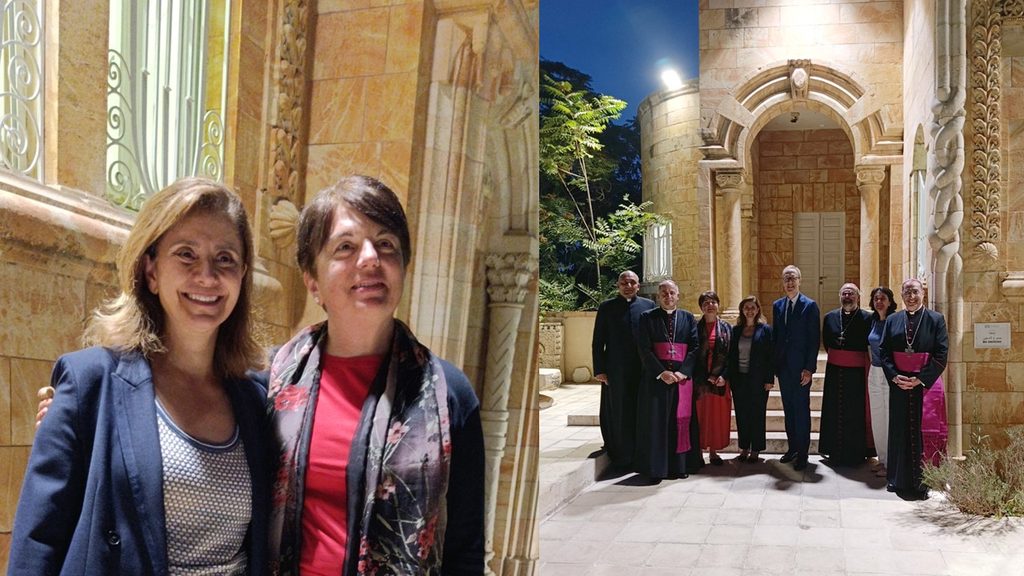
On September 7, the pilgrimage was welcomed at the Cultural Hub Bayt Yaish, in the historic district of Jabal Al-Weibdeh in Amman. This is an important cultural center dedicated to the enhancement of Jordan’s cultural heritage. Housed in a historic residence built in 1952, the building was restored thanks to collaboration between the Yaish family and the Petra National Trust, becoming a space devoted to culture, art, education, and heritage preservation.
At this venue, on September 7, 2026, at 6:00 PM, an international delegation gathered in the presence of Her Royal Highness Princess Dana Firas of Jordan, president of ICOMOS Jordan, the local section of the UNESCO Commission for the protection of monuments and sites.
The meeting was organized to welcome Archbishop Paolo Giulietti of the Archdiocese of Lucca and the pilgrimage delegation. The occasion also provided an opportunity to examine themes aimed at safeguarding dialogue among communities, history, local cultural identity, and religious heritage — a commission internationally presided over by Professor Olimpia Niglio University of Pavia and President ICOMOS PRERICO, she collaborates with Archbishop Giulietti in coordinating the project Thesaurum Fidei.
The Vatican diplomatic presence was significant, with Archbishop Giovanni Pietro Dal Toso, Apostolic Nuncio to Jordan and Cyprus; Rev. Giovanni Falorni, collaborator of Archbishop Dal Toso at the Apostolic Nunciature for Jordan and Cyprus; Rev. Humam Khzouz, judge at the Ecclesiastical Tribunal of Amman, Latin Patriarchate of Jerusalem; and Rev. Mario Cornioli, priest of the Diocese of Fiesole and fidei donum of the Latin Patriarchate of Jerusalem in Amman.
Italian diplomacy was represented by the Embassy of Italy in Amman, with Ambassador Pier Luigi Zamporlini and Dr. Francesco Ceravolo, First Secretary of the Embassy.
The pilgrimage concluded with an important meeting at the parish community led by Rev. Mario Cornioli, who for years has welcomed Syrian refugees, engaging them in productive activities and fostering the development of local craftsmanship.